
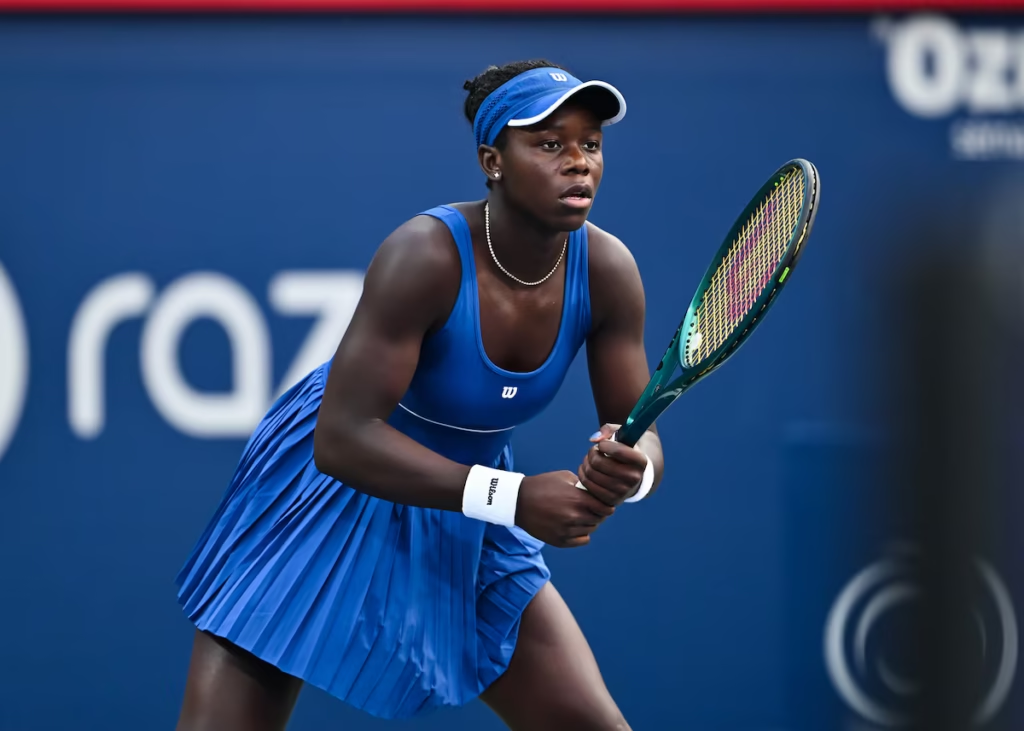
Victoria Mboko was never supposed to arrive this quickly. Tennis is a sport that demands patience, years of quiet climbing, incremental progress, and hard-earned breakthroughs before the biggest stages even come into view. But at just 19, Mboko has skipped the waiting line entirely. She has stepped into the upper echelons of women’s tennis with a presence that feels both completely new and somehow inevitable.
Her story stretches far beyond the baseline. Born to Congolese parents and representing Canada, Mboko carries with her a narrative of identity, diaspora, and visibility that resonates well beyond the court. For young girls across Africa watching from afar, perhaps catching a late-night stream, or following the scores on a phone with a cracked screen, she is proof that global excellence and African heritage can occupy the same space, unapologetically. In a sport where African representation at the top has historically been scarce, her presence does not just open a door. It reframes who the door was built for.
The numbers tell one part of the story. This season, Mboko reached a career-high ranking of World No. 9, becoming the fastest player to break from outside the Top 200 into the Top 10 since Jennifer Capriati did it in 1990. It is the kind of statistic that does not just highlight progress, it underlines how genuinely rare her trajectory is. But statistics, as clean as they are, cannot fully capture what it feels like to watch her play. There is something in the way she carries herself on court, unhurried, certain, like she has always belonged there, that numbers struggle to hold.
Her performances have made those numbers feel earned. At the Australian Open, she demonstrated she could hold her nerve in the deep end of Grand Slam tennis, converting pressure moments into momentum and staying composed when the stakes grew highest. Her quarterfinal run in Miami confirmed it was no fluke, most memorably in a breathtaking third-set tiebreak against World No. 1 Aryna Sabalenka, where she traded blow for blow with the best player in the world and refused to blink. These are the moments that shape careers. Mboko is shaping hers with both hands.
Her game reflects that same quiet confidence. The forehand is powerful and purposeful, her serve is growing into a genuine weapon, and her mental clarity in high-pressure rallies is the kind of quality most players spend years trying to manufacture. Mboko seems to carry it naturally, as if it were always hers to carry.
She is also part of a generation actively reshaping women’s tennis. Alongside players like Mirra Andreeva, Mboko represents a cultural shift in the sport, one defined not only by intensity and ambition but by mutual respect and a shared sense that they are building something new together. It is a generation that does not just want to win. It wants to change what winning looks like.
For HerGame Africa, her story holds a particular kind of weight. She is a cultural bridge, her Congolese roots tying her to a continent overflowing with potential, her success on the global stage carrying that connection into rooms where it has rarely been heard. Every match she plays is, in some quiet way, a message. To the girl in Kinshasa with a dream too big for her surroundings. To the young player in Lagos who has been told the path is too long, too expensive, too far. Mboko is not just competing. She is showing what is possible.
Speaking after her Miami run, Andy Roddick put it plainly: a Grand Slam title, he said, may not be far away. Coming from a former major champion, it lands less like a prediction and more like a quiet recognition of what the tennis world is beginning to understand.
Victoria Mboko is not a future star waiting for her moment. She is already in it, competing at the highest level, earning her place among the elite, and expanding what is possible for an entirely new generation watching from around the world. At 19, her story is only just beginning. But it is already one worth telling.
That’s HerGame. That’s our story. 🌍